
17 May 2026
The Apartment EV Crisis Is Coming
Apartment residents and renters risk being left behind if EV charging keeps assuming every driver has a garage, driveway, or standalone house.
6 min read
Public EV charging has improved, but the experience still asks too much of the driver.
You should be able to arrive, plug in, pay, and leave with what you came for - to charge. Yet, too often, the experience comes with a list of worries instead.
Will the charger actually work? Is the connector damaged? Do I need a new app? Will the payment go through? Is the charger really available, or just shown as available on a map? If the session fails, is the problem the car, the charger, the network, or the payment system?
That is why public charging can still feel like dial-up internet. When it works, it is impressive. When it does not, the driver is forced to troubleshoot a system that should be simple.
People are not only worried about EV range anymore. They are worried about the inconvenience of charging when the system does not work first time.
New Zealand needs public charging. Highway coverage, destination charging, and urban fast chargers all matter, especially for renters, apartment residents, tourists, fleet drivers, and people who cannot reliably charge where they live.
EECA’s 2025 EV charging research says home charging is still the most common form of charging in New Zealand, but public charging remains part of the mix for nearly half of EV and PHEV drivers. It also says one in five BEV and PHEV drivers are entirely reliant on the public charging network, and those drivers are more likely to be younger, Auckland-based, and renters.
That makes public charging reliability more than a road-trip issue. If public chargers are your backup, a broken charger is annoying. If public chargers are your main charging method, a broken charger can decide whether the car is usable tomorrow.
New Zealand is also early enough in its public charging buildout to avoid some of the worst overseas mistakes. The Ministry of Transport has already warned that as more charging providers enter the market, fragmented payment systems could make the driver experience worse. Its public charging discussion document specifically calls out the inconvenience of needing multiple memberships, accounts, and smartphone apps to use public charging.
That warning matters because the usability problem is not only about broken hardware. It is about the whole transaction.
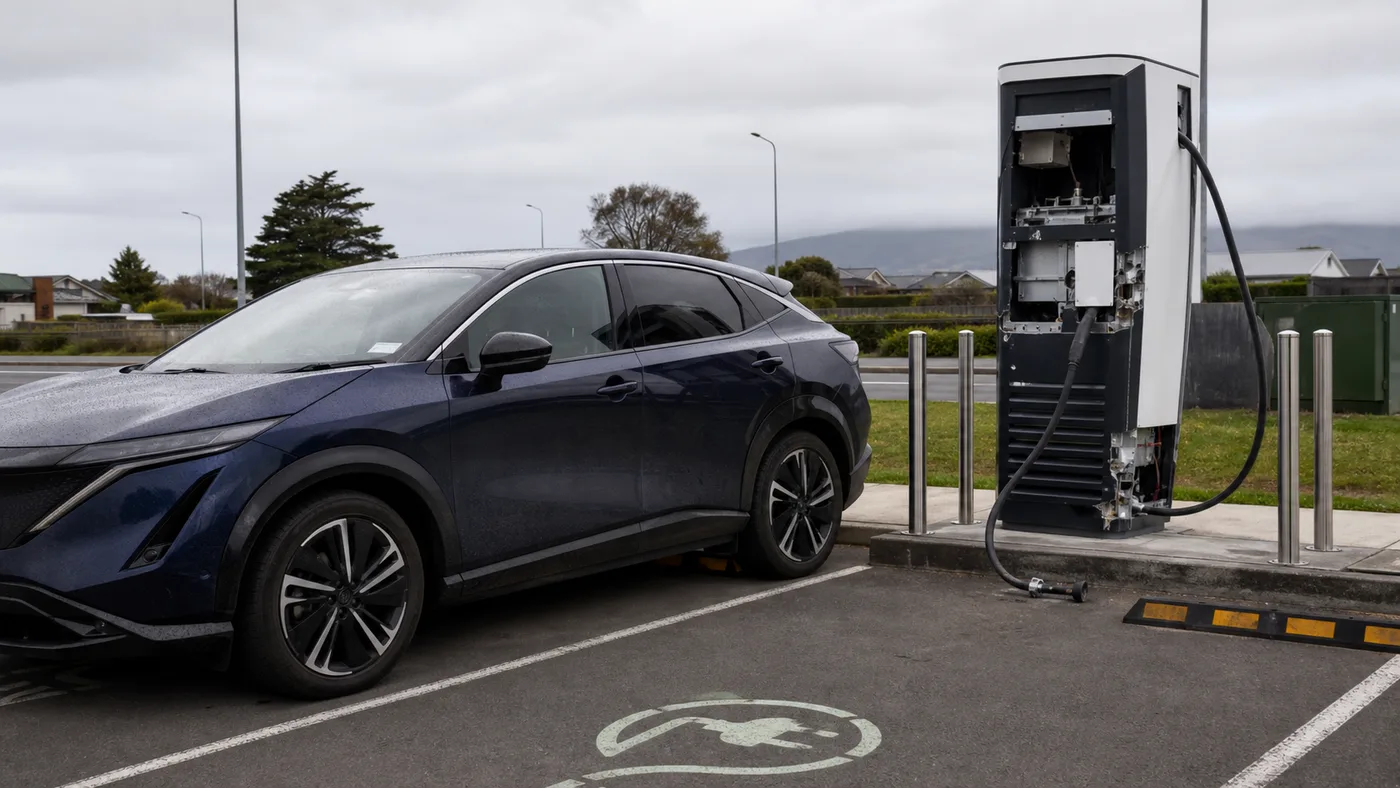
Public charger reliability is often reported as uptime. Drivers experience it as something much simpler: did charging start when I needed it to?
That distinction matters.
The lesson is not that every public charging network is bad. Many sites work well, and the best networks are improving quickly.
The lesson is that public charging is only as good as the weakest step in the session.
| Failure point | What the driver sees | Why it feels worse than a normal outage | | --- | --- | --- | | Broken connector or cable | The charger is there, but unusable | The map may still make the site look like an option | | Screen or terminal fault | The unit will not respond | The driver cannot tell whether the fault is temporary | | Payment failure | The charger works, but not for this user | The driver feels blocked by software, not energy supply | | App or account requirement | Charging starts with downloads and logins | The user must solve admin before getting power | | Network fault | The charger cannot authenticate or start | A local charging task depends on remote connectivity | | Vehicle-to-charger handshake issue | The session starts, fails, or derates unexpectedly | The driver does not know whether to blame the car or charger | | Single-port or low-redundancy site | One fault can remove the whole practical option | The fallback may be a long detour or a long wait |
This is why charger counts can be misleading. A charger that exists, but cannot start a session for the driver in front of it, does not feel like infrastructure. It feels like a promise that failed at the point of use.
It is easy to make fun of charging apps. Drivers do it constantly.
The complaints are familiar: too many apps, too many accounts, app stores tied to the wrong country, wallet top-ups, pre-authorisations, RFID tags, payment cards that fail, and stations that make a one-off driver behave like a returning subscriber.
But the app problem is really a fragmentation problem.
Public charging combines several systems that used to be separate:
When those systems are split across different operators, payment providers, hardware vendors, apps, and roaming agreements, the driver becomes the systems integrator.
That is the part people hate.
A petrol station does not ask a first-time driver to install a network-specific app, create an account, verify a phone number, load a wallet, scan a QR code, hope mobile reception is good enough, and then find out whether the pump will talk to the car. Public EV charging should not feel normalised around that much friction either.
The better direction is clear: open payment where appropriate, more reliable ‘live status’, fewer forced accounts, better redundancy at charging sites, shorter failure recovery times, and session-start flows that work for casual users as well as regulars.
Public charging reliability improves when operators stop treating “installed” as the win and start treating successful sessions as the win.
That usually means:
There are real tradeoffs. High-power public charging is expensive to build and operate. Rural and seasonal routes are hard to serve commercially. More operators can mean more competition, but also more apps and payment systems. Better redundancy costs money. Card readers and public terminals need their own maintenance.
So the honest answer is not “public charging is broken and should be avoided.”
The honest answer is that public charging should be used for the jobs it is best at: long-distance travel, fast top-ups, tourists, emergency backup, and drivers who genuinely cannot access private or shared-site charging.
For everyday charging, the industry needs to stop pretending that every inconvenience can be solved by another public fast charger.
WattSpot is not a replacement for the public fast-charging network. New Zealand still needs reliable fast chargers, especially on road trips.
But WattSpot solves a different part of the problem: routine long-dwell charging at shared sites where cars already sit for hours.
For apartments, body corporate parking, accommodation, workplaces, and similar sites, the better user experience is often not “drive somewhere else and hope the public charger works.” It is “plug in where the car is already parked, know the session started, and trust that the cost can be recovered fairly.”
That is a different design target from public fast charging. It puts more weight on:
This is the practical answer to public-charging frustration. Make the public network better, but also reduce how often ordinary drivers need to depend on it for ordinary charging.
People do not want a charging hobby. They want the car ready when they need it.
Explore the WattSpot charger range or get in touch to discuss your site.
Apartment residents and renters risk being left behind if EV charging keeps assuming every driver has a garage, driveway, or standalone house.
6 min read
Public chargers matter, but the bigger EV infrastructure gap is charging access where people already park.
7 min read