
17 May 2026
The Apartment EV Crisis Is Coming
Apartment residents and renters risk being left behind if EV charging keeps assuming every driver has a garage, driveway, or standalone house.
6 min read
Hotels, motels, and short-stay accommodation providers are watching EV adoption accelerate, but too many charging solutions feel out of touch or not fit for purpose.
The real problem is not that guests want the fastest possible charger. It is that many accommodation providers think they need to install expensive hardware, make a major electrical upgrade, and then add operational complexity in recovering costs fairly from guests.
Most high-power EV chargers are costly to buy, costly to wire in, and often do not help the property answer the toughest question: “How do we make charging an amenity guests can trust, without turning it into a disputed bill or a maintenance headache?”
But a changed paradigm may help reveal a more practical path forward for accommodation operators.
A hotel stay is almost always a long parking window.
Guests arrive, park, and then sleep, work, or explore the neighbourhood. That means that more often than not a guest’s charging demand does not require a short and high powered rapid charge.
For hotels, that paradigm shift changes the question from “how fast can I charge?” to “can guests plug in and trust the car will be ready when they leave?”. That shift can make all the difference in selecting EV charging solutions that match guest needs and may well be within the grasp of many hotel and motel operators.
This is already showing up in hotel booking behaviour. In July 2025, Skift reported that Hilton described EV charging as the highest-converting amenity on Hilton.com, ahead of traditional filters such as pools, on-site dining, and free breakfast. For accommodation providers, that makes EV charging more than a sustainability feature. It is becoming a booking driver.
A guest parking bay is usually available for 8–24 hours. That is enough time for a modest overnight charge from a 15 amp, 3.5 kW smart socket to add roughly 20 km of range per hour, which means a 10-hour stay can provide about 200 km of driving range. Where a site uses a 32 amp, 7 kW charger, the same 10-hour stay can add roughly 400 km of driving range.
That means accommodation charging should prioritise solutions that ensure:
Most hotel charging happens while the car is already parked for the night.
A smart socket can still add meaningful range across a normal stay.
A higher-power bay can add more range where the site and guest need justify it.
The practical question is often coverage and trust, with power matched to the stay.
Hotel guests do not want to feel they are being overcharged for the convenience of parking and plugging in.
For property owners and managers, the important part is that billing is easy to explain and hard to dispute. In shared-site charging, trust breaks down quickly if guests see surprising fees or if the property cannot show that charges match actual energy use.
Most accommodation sites have limited switchboard capacity, older electrical infrastructure, or a small budget for upgrades. That is especially true for hotels and motels today, many of which are already grappling with rising operating costs and cannot absorb a large new electrical upgrade bill.
That means the practical decision is often not whether you can install high powered 22 kW chargers, but whether you can deploy charging coverage across enough bays without causing a major electrical project or adding a disproportionate cost burden to the property. Guest coverage is key.
A hotel charging amenity must not become a daily burden for reception, housekeeping, or the maintenance team.
That rules out solutions that need constant monitoring, manual session management, or repeated guest education. The best property charging is the kind that stays working without staff having to babysit it.
There are three hotel-specific reasons to prefer a lower-power, higher-coverage approach:
That is why the better question for a property is often: “How many cars can we keep charged reliably?” instead of “How quickly can one car charge?” The answer is often cheaper, easier and more guest centric.
This can work for sites with a clear high-power use case, but it comes with tradeoffs. A single high powered 22 kW wallbox and its installation can often cost several thousand dollars, and a small bank of fast bays can push the project cost significantly higher.
This is usually the better fit for most guest accommodation charging because it matches the real guest need: overnight top-up, not a rapid fill.
The advantages are:
For some sites, a hybrid model can make sense:
That tradeoff is valid, but it only works if the property has enough coverage to prevent most guests from fighting over the same few fast chargers.
The biggest problems are not technical. They are often operational and financial.
A hotel can spend a lot on high-power fast chargers, but that only pays off if enough guests actually use them. For most short-stay accommodation, guests arrive and park for many hours, so overnight charging is the real need — not a few fast bays. If the stay pattern doesn’t match the charger type, the expensive fast chargers can sit idle or be available to only a small fraction of guests. That makes the investment poor value, because the property is paying for high-power hardware and installation without getting meaningful usage or guest benefit.
If charging fees are opaque or the property cannot easily show what was consumed, guest trust erodes quickly. That is especially true when multiple guests share the same charging pool.
A site can spend heavily on switchboard capacity for a few high power 22 kW bays and still end up with poor coverage, which is the opposite of what most overnight guest parking needs.
WattSpot is designed for the type of property charging that is most useful in shared, hosted, and accommodation settings.
That means the product fits best when the buyer needs:
For a hotel, that typically looks like a charging service that is easier to approve, easier to manage, and easier for guests to use than a wallbox-only roll-out.
In real terms, that usually means a lower-power overnight bay can be added for a few hundred to a couple of thousand dollars per bay, including install and wiring, while a high powered 22 kW wallbox plus the switchboard work it often requires can start in the high thousands per bay. It can climb much further if an electrical upgrade is needed. That cost gap is what makes accommodation charging more about coverage than headline power.
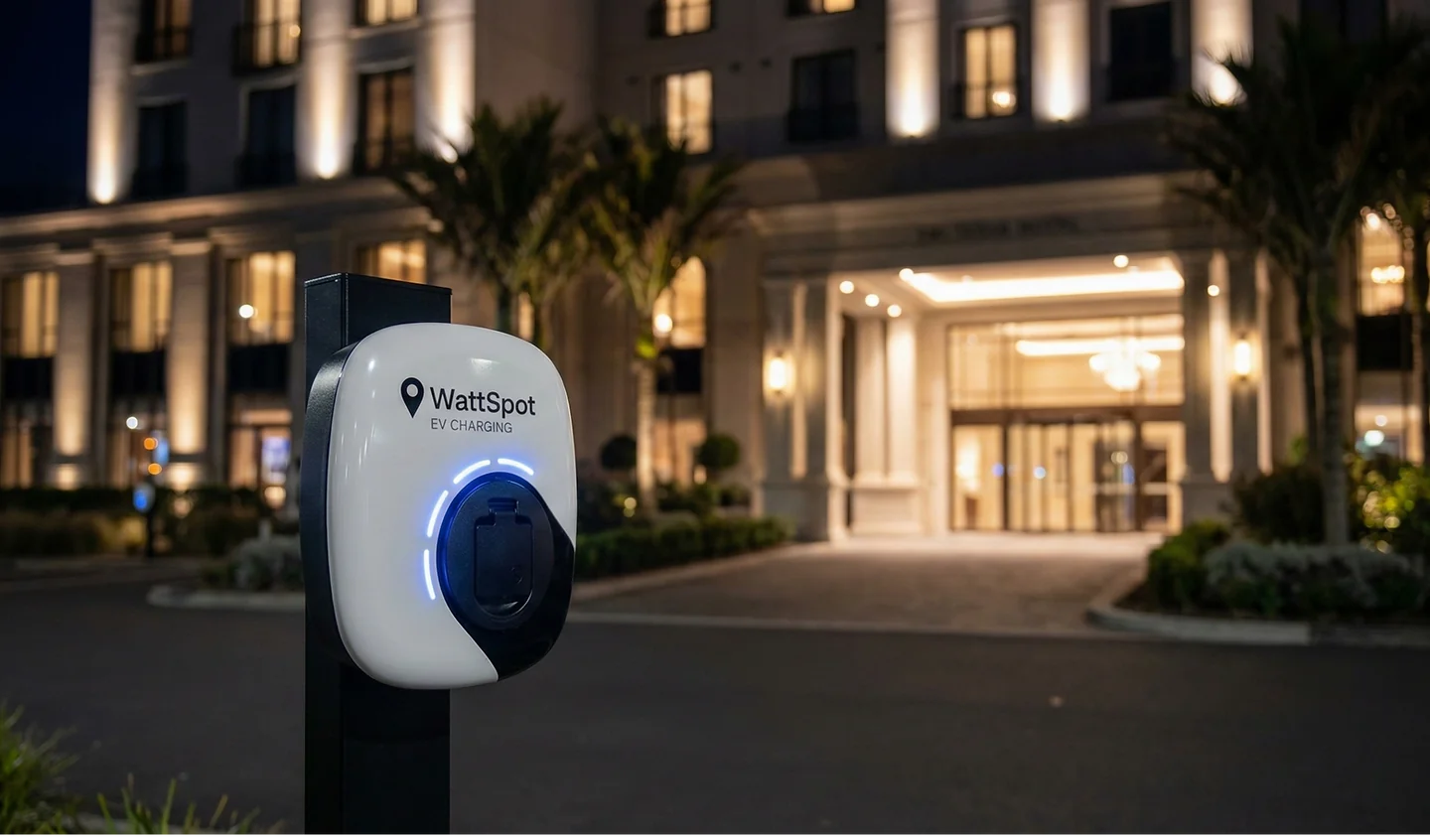
Guests should be able to arrive, park, plug in, and leave knowing their car has topped up while they sleep or explore.
That is the core need. Anything that makes charging feel like a separate task — an extra booking step, a confusing fee, or a maintenance headache — weakens the property amenity.
Why Charge with WattSpot, Scalable Rollout, Billing Trust, Everyday Convenience, Stress-Proof DependabilityExplore the WattSpot charger range or get in touch to discuss your site.
Apartment residents and renters risk being left behind if EV charging keeps assuming every driver has a garage, driveway, or standalone house.
6 min read
Public EV charging is improving, but broken chargers, app friction, payment failures, and weak first-try success still make it feel too fragile.
8 min read